
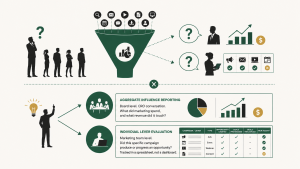


There’s a conversation happening in B2B companies everywhere. It sounds something like this.
Marketing: “We hit our MQL target. We sent over 200 leads last quarter.” Sales: “Those leads were terrible. We couldn’t close any of them.” Marketing: “That’s a sales problem, not a marketing problem.”
And round it goes. Marketing and sales alignment in B2B is one of the most persistent and expensive problems in go-to-market. It burns time, creates internal friction, and it doesn’t generate revenue. The root cause isn’t attitude. It isn’t communication. It’s misaligned goals. Fix the goals and the rest starts to follow.
Before we go further, one thing needs to be said clearly. The purpose of marketing is revenue. Every campaign, every piece of content, every event, every demand gen programme exists because the business needs to grow. Nobody in marketing should ever lose sight of that. The question isn’t whether revenue is the goal. It is. The question is whether revenue is the right metric for marketing to be measured against — and that is a different thing entirely.
Marketing doesn’t close deals. Sales does. The best marketing function in the world generates opportunities that a weak sales team will fail to convert. Holding marketing accountable to closed revenue means holding them responsible for a number they can influence but never fully control. That produces one of two outcomes: marketers who spend their time gaming attribution models to claim credit for revenue, or marketers who are penalised for things that happen after the lead leaves their hands. Neither is useful.
The reverse is equally true and worth saying out loud. A great sales team with strong outbound capability, deep relationships, and a founder who can sell can hit a revenue number with very little marketing support at all. It happens constantly at early stage companies. But that isn’t evidence that marketing is working. It’s evidence that sales is carrying it. And when that sales leader leaves, or the market gets more competitive, or the business needs to scale beyond what a handful of great reps can personally reach, the absence of a functioning marketing engine becomes very expensive very quickly. Revenue can flatter marketing the same way it can punish it.
Revenue is why marketing exists. Pipeline is how you know if it’s working.
The Problem with MQLs
Marketing Qualified Leads aren’t a bad idea. The concept is sound: identify signals that suggest a prospect is worth sales attention, and pass them over. The problem is in execution.
Most MQL frameworks are built around what marketing can measure, not what sales can convert. Lead score thresholds. Email open rates. Content downloads. Form fills. These are activity metrics. They tell you someone did something. They don’t tell you whether that person has a problem your product solves, the budget to buy it, or the authority to sign anything. And when MQL volume becomes marketing’s primary success metric, the incentives go wrong fast. Definitions get stretched to hit targets. Lower-quality signals get included. The numbers look good in the board deck and do nothing for revenue.
Sales stops trusting the leads. Marketing stops trusting sales to work them. Both teams are busy. Nothing closes.
I actually like MQLs. I believe that they have a have a role as an early-stage signal in a longer qualification process. The mistake is treating them as an outcome rather than an input. I also believe that when we define an MQL correctly and have a tight threshold they can be useful. For example a client I worked with, we decided that a lead would qualify as an MQL only if it filled in a “hand raiser form” examples, Demo Request, Contact Us, Quote. Basically, they are asking for assistance. The other qualification route was when they accepted a BDR meeting.

Pipeline Is Marketing’s Goal
Marketing’s primary goal should not be MQL volume. It should be pipeline generated.
Not revenue. Revenue is a company goal and it sits with the whole go-to-market team. Pipeline is different. It’s the set of qualified opportunities that sales is actively working. It’s the output of good marketing and good qualification combined. And when it becomes marketing’s number, everything about how the function operates starts to shift. Demand gen leaders start asking whether campaigns are generating conversations with the right companies, not just generating clicks. Whether a trade show produced actual opportunities or just badge scans. Whether the ICP definition is tight enough, or whether they’re flooding sales with people who will never buy. Quality stops being something that sits in a values statement. It becomes a commercial imperative, because it’s what marketing is being measured on.
This Changes Your Team Structure
If marketing owns pipeline, there’s one logical conclusion that many leadership teams resist: marketing needs to own the BDR and SDR function.
SDRs are the only people in the go-to-market team who actually create an opportunity. They take a lead, qualify it properly (BANT, the front end of MEDDIC, whatever framework fits your business) and open a real sales conversation. They sit at the exact boundary between marketing activity and sales activity, and which team they report to determines everything about how they operate. BDRs and SDRs sitting inside the sales team get measured on appointments set, on meeting volume, on activity metrics that may or may not produce qualified pipeline. They become appointment setters, not qualifiers. Move them into marketing, measure them on pipeline created alongside the demand gen team, and the entire approach changes. Demand gen asks what leads SDRs are actually converting. SDRs feed back what signals are worth chasing. Everyone is trying to solve the same problem.
This is the structural change that makes alignment real rather than aspirational.
How the Team Starts to Think Differently
When the goal is pipeline, the mindset shift runs across the whole function. Campaign teams stop optimising for impressions and start asking what actually converts. Intent data gets taken seriously. Target account lists get challenged. Content gets built around real objections and real questions rather than because it’s in the content calendar. Events stop being measured by badge scans and start being evaluated on whether the right people were in the room and what came out of it commercially.
None of this requires hiring different people. It requires giving people a different goal.
It Starts with Goal Setting
Marketing leaders and sales leaders need to sit down and agree on three things before anything else.
What does a qualified opportunity look like? Not a lead score. A description of a real buyer with a real problem, the right company size, the right industry, the right trigger events, the right level of engagement with the business. What is marketing responsible for? Pipeline generated. MQL volume, website traffic and email open rates are inputs. Pipeline is the output. And how will progress be measured? Weekly pipeline reviews with both marketing and sales in the room. Marketing pipeline contribution tracked in the CRM. No separate scorecards that let either team claim success while the other claims failure.
When these three things are genuinely agreed, the blame game becomes structurally impossible. Both teams win when pipeline grows. Both teams lose when it doesn’t.
A Note on OKRs
Getting the goals right at leadership level is the first step. Getting them to land across the team is where most companies fall short. OKRs, done properly, are the mechanism that closes that gap. When marketing teams run on OKRs, every individual can see the direct line between their daily work and the company’s commercial goals. The demand gen manager knows what they’re contributing to. The SDR knows what success looks like. The Head of Marketing has a single view of whether the function is moving the needle. Done badly, OKRs are a bureaucratic exercise that adds meetings and subtracts motivation. Done well, they create ownership and accountability that most marketing teams have never had. Worth a separate post in its own right, but if you’re thinking about how to operationalise the alignment above, this is where to start.
The Shared Goal Changes Everything
Marketing and sales misalignment is a goal problem dressed up as a people problem. Fix the goals and the conversations change. Campaigns get more purposeful. SDRs qualify harder. Sales trusts what comes through the door. Pipeline grows.
It starts with one decision: marketing owns a pipeline goal, not just leads.