

Before we get into MQL definitions for B2B SaaS, one thing needs to be established. If you haven’t already accepted that pipeline is marketing’s primary goal, this post will be less useful than it should be. MQLs exist to serve that goal. They are not the goal themselves. If your marketing team is still being measured primarily on MQL volume, the definition problem is actually a goal problem, and that’s worth fixing first.
Assuming you’re with me on pipeline: here’s how to build an MQL definition that works.
Diagnosing the Problem First
Most teams don’t need a new MQL definition. They need to understand why their current one isn’t working. Before building anything, it’s worth being honest about which of these situations you’re in.
Your MQL volume looks healthy but pipeline isn’t growing. This almost always means the definition is too loose. Leads are being marked as MQLs based on activity that looks like intent but isn’t. A prospect who downloaded three pieces of content and attended a webinar is engaged. They are not necessarily ready to talk to anyone. If your SDRs are spending time chasing those people and converting very few of them, the definition is doing harm. This is leading to bad Sales and Marketing Alignment and lack of pipeline.

Your MQL volume is low and sales is complaining about not enough leads. This is sometimes a genuine pipeline problem, but it’s more often a sign that marketing is being conservative with the definition to avoid handing over leads that get rejected. The definition has become a defensive mechanism rather than a commercial one.
Sales regularly rejects MQLs or ignores them entirely. This is the clearest signal that marketing and sales don’t agree on what an MQL means, and they’ve probably never sat down to define it together. The definition was built by marketing, for marketing, and sales has no ownership of it.
If you recognise any of these, the definition you have isn’t fit for purpose. Here’s what fit for purpose looks like.
What an MQL Actually Is
An MQL is a hand raise. Nothing more, nothing less.
It is the moment a prospect has explicitly signalled that they want to talk to someone. A demo request. A contact form submission. A pricing page inquiry. A direct reply to an outbound sequence saying yes, I want to know more. The prospect has done something active and deliberate that says I am interested enough to engage with a human being from your company.
That is the threshold. Below it, you don’t have an MQL. You have a lead who is doing what leads do, which is consuming information, evaluating options, and not yet ready to talk.
The reason this definition works is that it removes interpretation. You don’t have to decide whether a lead score of 47 is high enough, or whether three content downloads indicate intent, or whether someone who visited the pricing page twice in a week is ready for a call. The prospect has told you. That is the signal. Everything else is noise that belongs somewhere else in your system, and we’ll come to that.
Once an MQL is created, the SDR picks it up, qualifies the conversation properly, and books the meeting. The MQL is the trigger for that process. The meeting booked is the outcome. Marketing owns the MQL. The SDR owns the conversion from MQL to meeting and from meeting to opportunity.
What an MQL Is Not
This is where most definitions fall apart, because the boundary between MQL and not-MQL gets blurry when you’re trying to show volume.
An MQL is not someone who opened four emails. It is not someone who downloaded your buyer’s guide. It is not someone who attended your webinar and didn’t ask a question. It is not someone who visited your website multiple times this week. All of these are signals worth tracking. None of them are hand raises.
These leads have a home. It’s called a Marketing Accepted Lead, and treating them as such rather than MQLs is what keeps your pipeline data clean and your SDR team focused on conversations that are actually likely to convert.
The MAL: Marketing Accepted Lead
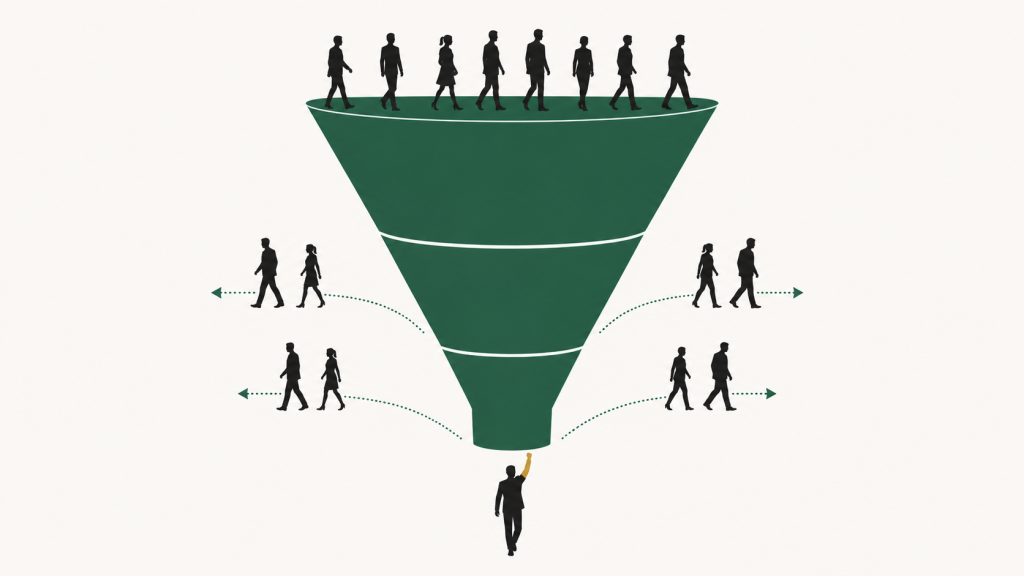
A Marketing Accepted Lead is a lead in your system who has engaged with your content or brand in a way that suggests they could eventually become a buyer, but hasn’t yet indicated they want to talk to anyone.
They’ve downloaded content. They’ve attended events. They’ve engaged with emails. They’re in your world, and that matters, because when the time is right for them, you want to be the company they think of first. The MAL sits in a nurture track. Marketing looks after them. SDRs don’t touch them. And the honest reality is that not every MAL will ever become an MQL. Some will go quiet. Some will turn out to be the wrong fit. Some will buy from a competitor. That’s fine. The point of the MAL is that you’re not ignoring these people and you’re not misclassifying them as something they aren’t.
When a MAL raises their hand, they become an MQL. Until then, they stay in the nurture track and marketing keeps them warm. This is where content strategy earns its keep, because the content that moves a MAL toward an MQL is different from the content that generates a MAL in the first place.
PQLs and AQLs: When MQLs Aren’t the Whole Picture
In some businesses, the MQL isn’t the only or even the primary lead type that feeds pipeline. Depending on your go-to-market motion, you may also be working with Product Qualified Leads or Account Qualified Leads, and understanding how these fit alongside the MQL, or sometimes replace it, matters.
A Product Qualified Lead (PQL) is used in product-led growth businesses where the product itself is the primary acquisition channel. A PQL is a user who has reached a specific threshold of product usage or engagement that indicates they’re getting value and are a good candidate for a commercial conversation. Think a free tier user who has hit usage limits, or a trial user who has completed a set of actions that correlate with conversion to paid. The PQL is the hand raise in a PLG motion. It’s just that the hand raise comes through product behaviour rather than a form fill. Where both an inbound marketing function and a PLG motion exist in the same business, you’ll often have MQLs and PQLs running in parallel, feeding different SDR workflows with different qualification criteria.
An Account Qualified Lead (AQL) is used primarily in account-based marketing. Rather than qualifying individual leads, the AQL approach qualifies accounts — meaning the whole company — against your ICP before any individual lead is created. An account gets marked as an AQL when firmographic data, intent signals, and engagement from multiple contacts within the business meet a threshold that says this company is worth pursuing. The AQL feeds a coordinated, multi-threaded outbound approach rather than a single lead nurture. It sits alongside the MQL in a hybrid motion where you’re running both inbound and ABM, or it replaces the MQL entirely in a business doing pure enterprise ABM with no meaningful inbound channel.
The mistake most teams make is treating PQLs and AQLs as variations of the MQL and folding them into the same workflow and reporting. They aren’t variations. They’re different signals generated by different motions, and they need different responses. Getting clear on which motion your business is running, and which lead type is primary, is the starting point for building a definition that actually holds.
Building the Definition Together
Whatever lead type or combination of lead types your business uses, the definition only works if both marketing and sales own it. Not marketing defines it and presents it to sales. Both teams sit down, agree on what a qualified hand raise looks like in your specific business, and sign off on it together.
That agreement should cover what actions trigger an MQL, what firmographic or ICP criteria a lead needs to meet before they’re even eligible, what the SDR is expected to do with an MQL and in what timeframe, and what happens when an MQL doesn’t convert so that the data feeds back into the definition over time.
A definition without that feedback loop will drift. The ones that hold are reviewed quarterly, challenged when conversion rates drop, and updated when the ICP evolves. They’re a living agreement, not a one-time document.