


Attribution had its moment. For a few years it felt like every startup marketing function was heading towards that conversation, and its one I still have with founders, multi-touch models, new dashboards, first-touch vs last-touch debates. A handful of well-funded martech vendors pushed it hard, and it worked. Attribution became the thing every marketing team was supposed to have solved.
Here’s the problem: attribution means something completely different depending on the size of the company and the stage it’s at. And most teams are trying to force one model to answer two different questions.
What attribution actually needs to tell you
There are really only two questions worth asking:
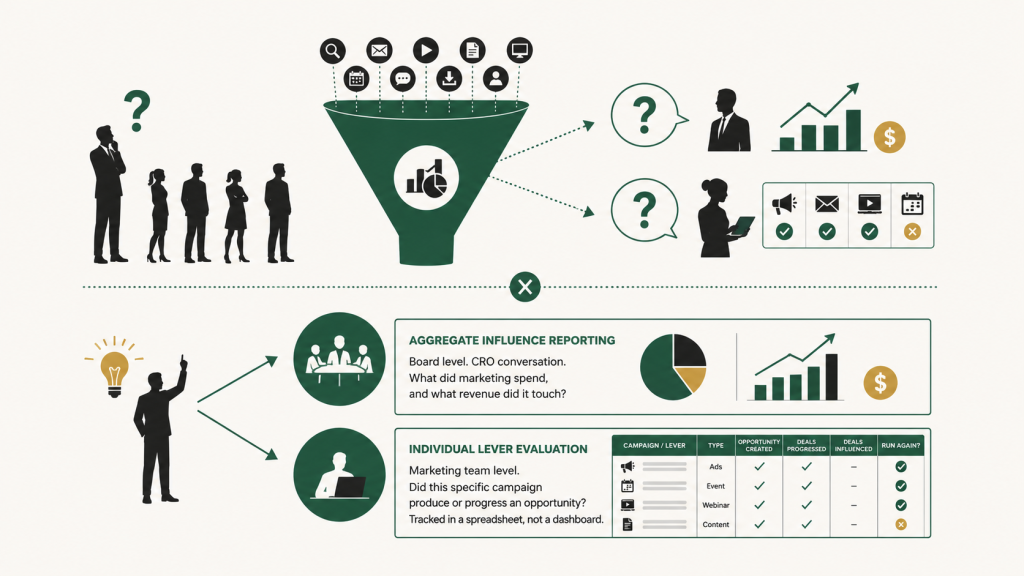
- What is marketing contributing as a whole? (Board level. CRO conversation. Total spend vs total influenced revenue.)
- Which specific campaigns or levers are working, and which should we do again? (Marketing team level. Optimisation conversation.)
- At the later stage – what levers impact the buyer journey at what stage.
One dashboard doesn’t answer both well. Trying to make it do so is where most attribution projects go wrong.
Where multi-touch attribution genuinely earns its keep
At enterprise level, with multiple stakeholders and multiple buyer personas moving through a long journey, a proper multi-touch model does useful work. It links the different people in a buying committee to the different content and channels that reached them, and gives you a real read on where information is landing and what’s working. That’s a fair use of the model — the complexity of the buying group matches the complexity of the model.
Where it falls apart at early stage
I’ve sat with founders who say some version of “I don’t know where my money’s going,” and the response is usually a marketer reaching for a martech tool — DreamData, HockeyStack, or (a few years back) Visible — and bolting on a first-touch, last-touch, or linear model. In my experience it fails for three specific reasons, not just because “attribution is hard”:
1. Not enough deal volume for a model to mean anything. A multi-touch model needs a statistically meaningful number of closed deals flowing through it before the weighting means anything. At Series A or B, you might be closing a handful of deals a month. Run a model against that and you’re not looking at a pattern — you’re looking at noise dressed up as a percentage.
2. No one owns the data hygiene to make it honest. Multi-touch attribution is only as good as the touchpoint data feeding it — every ad click, every email open, every event scan tagged and flowing cleanly into the CRM. Enterprise companies have RevOps teams whose job is exactly that. Early-stage companies don’t. So the model runs on patchy, inconsistently tagged data and hands back numbers that look precise and aren’t.
3. Different campaign types need different logic, and one model can’t flex between them. A single point campaign — a trade show, say — is clean. Someone attends, becomes a lead, becomes an opportunity. You can draw a straight line from the trade show to the deal it created.
An influence campaign is a different animal. A prospect sees a few ads along the way. Good signal, but it’s a different channel with a different budget, doing a different job. Now stretch the journey out: a Google ad six months ago, a webinar, a trade show, then — right at POV stage, deep in contract conversations — you bring them to an executive dinner, and they sign.
Run a last-touch model on that and the dinner gets credited with the deal. It shouldn’t. The dinner didn’t create most of that value — the six months of work before it did. Believe the model and you’ll conclude you need a hundred more executive dinners, while quietly starving the Google ads, the webinar, and the trade show activity that actually built the pipeline in the first place. You’ve optimised for the wrong lever, because you asked one model to treat a single-touch campaign and a long-influence campaign the same way.
Two levels, two jobs
At the top, aggregate level — marketing budget against revenue associated with campaigns, whatever they are: ads, events, webinars, content, community — that’s useful. It’s good for board numbers, good for budget conversations, good for saying “this is what we spent, this is what we contributed.”
At the individual campaign level, the job is different again. When we run an event, we look at what it actually generated and delivered: opportunities created, deals progressed, deals influenced. Those are good buyer signals, and they tell us whether that lever is worth using again next month or next year. But you can’t take something like an executive dinner and force it into a first-touch or last-touch framework. It just doesn’t hold up.
The multi-touch over-counting problem
There’s a second issue that rarely gets talked about. If a deal has, say, seven touches across the journey, and you run a multi-touch model that spreads credit across all of them, then roll those numbers up across every campaign — you can end up reporting more total revenue than you actually generated. The maths of “share of credit per touch” doesn’t sum cleanly across a whole pipeline once journeys get long and messy.
That over-count isn’t really the point, though, and it’s not worth chasing perfection to fix it. The real issue is that you’re using one model to try to answer both of the questions above, and it can’t do either one properly as a result.
Stop buying a model. Start answering two questions.
If you’re pre-Series B, I’d argue a multi-touch attribution tool is probably a waste of your money and your marketer’s time — you don’t have the deal volume or the data hygiene to make it honest, and you’re trying to make one model answer two jobs it was never built to do at once.
What you need instead is two separate, much simpler views:
- Aggregate influence reporting, for the board and the CRO conversation — what did marketing spend, and what revenue did it touch.
- Individual lever evaluation, for the marketing team — did this specific campaign produce or progress an opportunity, yes or no. Tracked in a spreadsheet, not a dashboard.
Neither view needs to be perfectly precise down to the pound. They need to be honest, consistent, and built for the decision they’re actually informing. That’s a very different design brief to “buy a multi-touch attribution tool and turn it on.”